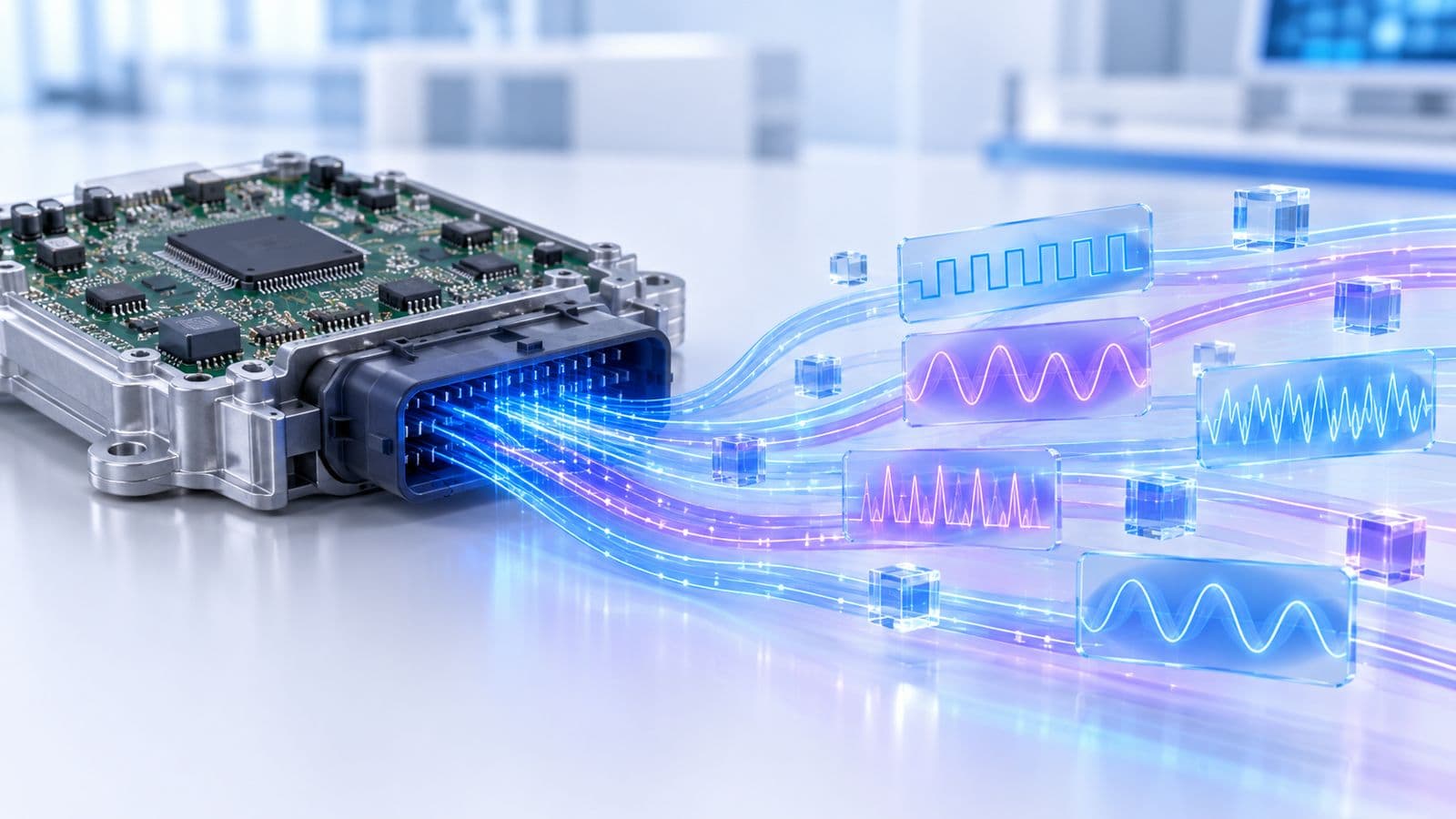
Ask a team that builds a diagnostic tool, a test bench or a software-defined-vehicle application where its first months went. The answer is rarely the feature. It is the groundwork underneath it: connecting interfaces, capturing frames, parsing protocol databases, naming signals and recording sessions for colleagues. And the next team builds the same groundwork again.
The hidden project inside every vehicle-software project
Vehicle-network data is the raw material for a growing number of applications: engineering tools, test automation, data logging, analytics and, increasingly, applications that run on a software-defined vehicle. Each of them needs the same basic path from the network to a named, scaled signal.
Because that path is rarely available as a dependable product, teams write it themselves. It starts as a small script and grows into a private platform that nobody planned, nobody budgeted and only one or two engineers fully understand.
The pain points we hear most often
- Fragmented tooling: one tool to capture, another to decode, scripts to glue them together, and nothing that behaves the same on a desk, on a bench and in automation.
- Months spent on groundwork: interface handling, reconnects after a device is unplugged, file rotation and protocol-database parsing are rebuilt for every new program.
- Data locked inside tools: recordings in proprietary formats can only be opened by whoever holds the right licence seat.
- Signals that do not travel: each application decodes raw frames on its own, so the same signal ends up with different names, scaling and bugs.
- A gap between bench and application: new vehicle applications need live, named signals, while bench data stays at frame level.
- Desk testing is hard: without reliable replay, every reproduction needs the vehicle or the full test bench.
Engineers should spend their time on the feature, the test or the insight, not on re-implementing capture and decoding for the fifth time.
What it really costs
The direct cost is engineering time that never reaches the customer-visible feature. The indirect costs are larger: results that differ between teams because each one decodes differently, slow onboarding for new engineers, and fragile in-house code that becomes a risk whenever its author moves on.
How INSIGHTZ.SDK changes the starting point
INSIGHTZ.SDK gives teams that groundwork as a ready platform, so they start from working services instead of an empty repository. The same workflow is available from the SDK, a command-line tool and ready-made desktop applications:
- Connect: discover the CAN and Ethernet interfaces on a workstation and select the ones to use.
- Capture and record: capture live traffic with automatic reconnect, and record it to standard formats with file rotation and a session record.
- Decode and map: import DBC and CAN ARXML files and map decoded values to named vehicle signals.
- Use the signals: read, publish and subscribe to signals from your own applications, and replay recordings on the desk with a timeline and trace browsing.
Because your applications, the command-line tool and the desktop applications share one platform, a signal means the same thing everywhere. What an engineer sees on the desk is what the automation sees on the bench.
Ready for the Yoriito vehicle API
Yoriito is the open-source vehicle API project promoted by JASPAR. Applications built for it need real vehicle data to be developed and tested properly. INSIGHTZ.SDK bridges live and recorded CAN, CAN FD and automotive Ethernet traffic to the Yoriito Kura signal broker, with signals named to the Yoriito vehicle data model.
That means a Yoriito application can be developed against real network behavior on a desk, long before a complete vehicle is available. INSIGHTZ.SDK is an independent Langidge product and is not endorsed by JASPAR.
Protocols and formats supported today
- Vehicle networks: CAN, CAN FD, automotive Ethernet and ISO-TP.
- Protocol databases: DBC and CAN ARXML import.
- Recording formats: PCAPNG, PCAP and ASCII.
Next objectives include LIN and FlexRay monitoring, CAN and CAN FD transmit with scheduling, gateway and rest-bus simulation, versioned configurations and a developer kit for proofs of concept. Delivered and planned features are documented separately, so teams always know what they get today.
Who benefits
- Tool and test-bench developers who want to stop maintaining their own capture and decoding code.
- Software-defined-vehicle and Yoriito application teams who need real signals early.
- Validation automation engineers who need the same data on the desk and on the bench.
- Organizations with several sites that need consistent, shareable recordings and signal definitions.
Getting started
We run evaluations with teams that want to test INSIGHTZ.SDK on their own interfaces and protocol databases. Tell us about your program and the networks you work with, and we will propose an evaluation scope.