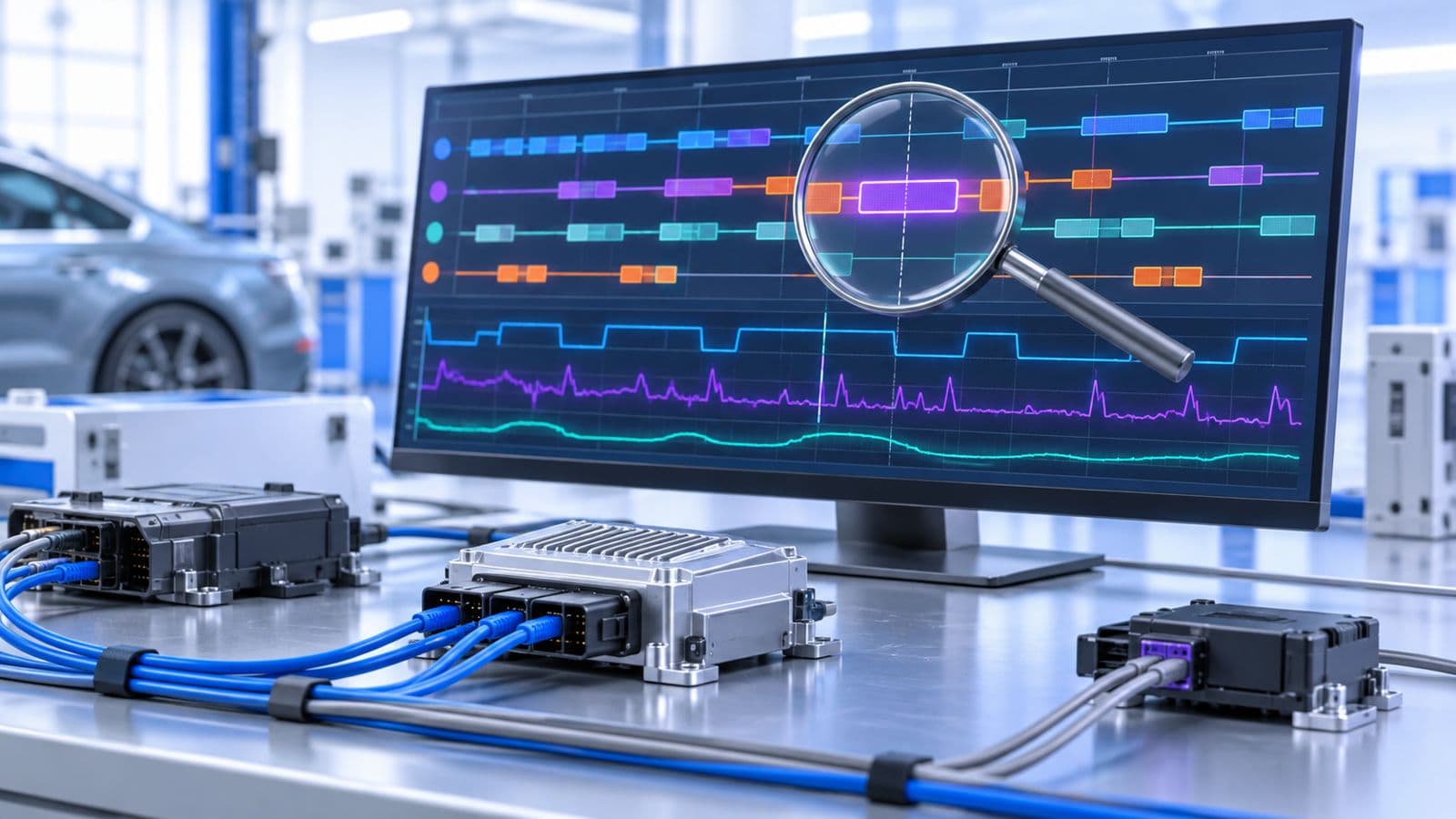
A test fails intermittently on the bench. The capture runs on one machine, decoding happens in another tool, the plots come from a script, and the bench PC runs a different operating system from the analyst's laptop. By the time the packet and the signal finally line up, most of the day is gone. This is everyday reality for many validation teams.
Where validation time really goes
Modern vehicle networks mix CAN FD and automotive Ethernet, carry more traffic than ever and change with every software release. Validation teams are asked to cover more scenarios in less time, often around the clock. Yet a large share of their effort goes into moving data between tools rather than understanding it.
The pain points in V&V teams
- Too many tools in the chain: capture, decoding and visualization live in separate tools, each with its own format and export step.
- Mixed protocols, split views: CAN FD and automotive Ethernet are analysed separately, even when one fault crosses both.
- Manual decoding: engineers translate bytes into physical values by hand or with one-off scripts.
- Windows and Linux splits: benches and desks run different operating systems, so tools need virtual machines or duplicate setups.
- Slow under load: analysis becomes sluggish exactly when traffic is heaviest and the problem is most likely to appear.
- Hard to reproduce: intermittent issues send the team back to the bench because recordings cannot be replayed with full context.
The question is rarely “what was on the bus?” It is “which signal changed, when, and why?”
One connected workflow with INSIGHTZ.ANALYSIS
INSIGHTZ.ANALYSIS is built for that question. It brings the steps of an investigation into one connected workflow, so analysts move from packet context to signal-level answers without switching tools:
- Mixed-protocol capture: CAN, CAN FD and automotive Ethernet traffic in one session.
- Trace and lifecycle intelligence: follow a message from the raw packet to its session and timing context.
- Protocol-driven decoding: physical values from your protocol definitions instead of manual byte work.
- Unified signal view: compare decoded signals in one consistent view and avoid fragmented interpretation.
- Offline replay: reproduce a session on the desk with its full context, without returning to the bench.
- Windows and Linux: the same analysis workflow on both platforms, keeping distributed teams and benches aligned.
Built for heavy traffic
Performance is a design requirement, not an afterthought. INSIGHTZ.ANALYSIS is engineered with a Phase 1 target of around 50,000 packets per second and focuses on staying responsive during heavy capture sessions, when investigations matter most.
What changes for the team
- Less context switching between capture, decoding and plotting.
- Consistent interpretation of signals across sites and shifts.
- Fewer toolchains, virtual machines and duplicate bench setups to maintain.
- Faster, better-documented root-cause analysis that can be shared with development teams.
Combined with our validation approach, customers target up to a 60% reduction in engineering effort, a 50% improvement in validation coverage and 50% faster test results with 24/7 testing. Actual results depend on program scope.
Product and services together
INSIGHTZ.ANALYSIS is part of our wider validation practice. Our validation services range from SIL to HIL, including OTA and cybersecurity validation, and the CUTS accelerators add ready-to-deploy modules for signal intelligence, connectivity gateways, ECU and bus simulation, and test automation. Teams can adopt the product on its own or work with us to plan, set up and run complete validation benches.
Next step
If your team spends more time moving data between tools than finding root causes, we would like to hear about your bench and your protocols. We will show how INSIGHTZ.ANALYSIS fits into your existing workflow.