Waste to energy

Waste plastic to fuel oil

A continuous plant that converts waste plastic and rubber into wax-free fuel oil, gas and carbon, with no waste stream left over.

Waste plastic, tyres and rubber are recognised worldwide as environmental and social problems. Langidge introduces a technology developed by an engineering partner in Pune, India, that recovers energy from this waste and turns urban and industrial plastic into fuel for industry.

Partner solution introduced by Langidge. Specifications and figures are provided by the partner and should be confirmed for your application.

About the technology

The partner reports that it has developed, demonstrated and commercialised this technology for producing wax-free fuel oil from waste plastic, and has processed solid waste from paper mills in a continuous plant with zero discharge in India.

Waste from these units is converted into three useful products:

  • Gaseous fuel that can be reused to run the plant
  • Liquid fuel suited to industrial use, which can be converted to heat or electricity as required
  • Carbon briquettes that make full use of the raw material

How the plant works

The plant runs as a continuous process rather than in batches. Gas produced by the process is reused to heat the reactor.
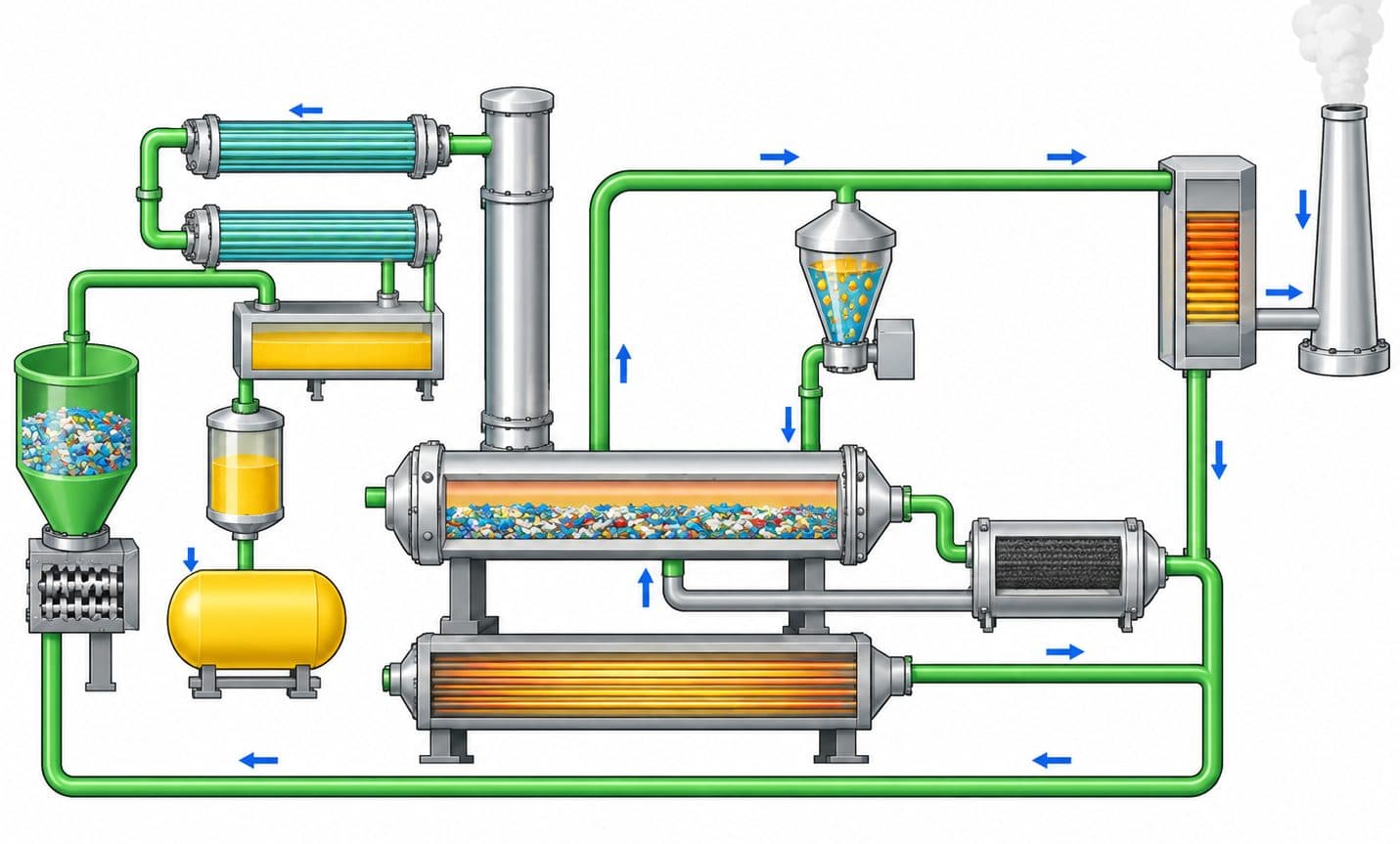
Illustrative process diagram: shredder, pyrolysis reactor, vapour column, condensers, oil tanks, gas storage, heat recovery and stack
Illustrative diagram based on partner documentation.
  1. 01

    Shredder

    Waste plastic is shredded to the required particle size and fed into the plant.

  2. 02

    Pyrolysis reactor

    A continuous reactor, heated by a hot air generator, converts the plastic into vapour.

  3. 03

    Carbon removing system

    Solid carbon is removed from the reactor continuously and can be made into briquettes.

  4. 04

    Vapour column and condensers

    Vapour rises through the column and is condensed into liquid fuel.

  5. 05

    Oil gas buffer, refiner and receiver

    The liquid is buffered, refined and collected as fuel oil.

  6. 06

    Gas storage

    Non-condensable gas is stored and reused to heat the plant.

  7. 07

    Heat recovery and stack

    Heat is recovered from the hot air circuit before exhaust leaves through the stack.
Key features

  • Plastic and rubber can be processed in the same reactor (operated separately); sharing the reactor roughly halves the investment and can almost double the speed of payback
  • Complete recycling with no useless by-products: the outputs are gas, carbon and oil
  • No high temperature or high pressure required, according to the partner's specification
  • Low-cost, high-productivity process with no pre- or post-processing of outputs
  • The same technology can also be used for gasification, with less soot and no new investment
  • The fuel produces very little SO₂ and has a higher gross calorific value than other fuels
  • Low moisture, low density and low viscosity: ignites at ambient temperature without pre-treatment
  • Low noise, with no odour from outputs or during processing
  • Continuous furnace and process for 24-hour operation, unlike batch-type furnaces

FIREFAST fuel oil

  • Zero wax in the fuel
  • Low density and good flow properties
  • Low viscosity, so it burns easily and efficiently in oil burners
  • Atomises easily at moderate oil pressure
  • Higher calorific value than heavy fuel oil; no preheating needed
  • Low sulphur content, so SOx emissions are very low
  • Low moisture content; low flash and ignition points
  • An economical alternative to fossil fuels such as LDO and FO, with a higher gross calorific value
  • Using it instead of LDO or FO helps reduce plastic and rubber pollution

Feedstock requirements

  • Accepted polymers only: unsuitable polymers can disrupt plant operation
  • Sorted waste: no metal, stone, glass, rubber, cloth or other impurities
  • Clean waste: free of dust, mud, sand and other dirt
  • Dry waste: moisture content below 5%
  • Particle size: 10 mm to 25 mm, shredded, crushed or agglomerated

Accepted polymers

  • LLDPE
  • LDPE
  • MDPE
  • HDPE
  • PP
  • PS
  • HIPS
  • HM
  • Polyester-coated films (up to 10% of the total mix)

Not accepted

  • PVC
  • Polyester
  • Polycarbonate
  • Glass-filled polymers
  • Polysulphides
  • PBT (polybutylene terephthalate)
  • Nylon
  • ABS

Other projects

How can we help?

Tell us about your business plans or your engineering program. We will route your message to the right team.